Open-source beta for macOS
One home for the notes you choose to keep.
Save a note in Claude. Find it later in Codex, even when you ask differently. Afternote keeps the notes you choose in an encrypted vault on your Mac, with local search by meaning and control over each connected tool.
Free beta. Apple Silicon · macOS 13.3+. No Afternote account. Release notes and checksums.
Independently maintained, best-effort beta. Beta notice and license · Local privacy.
Illustrated workflow with synthetic work notes. The recall example was checked against the bundled local search models. Read the transcript.
One note, across your tools
Ask differently. Find what you saved.
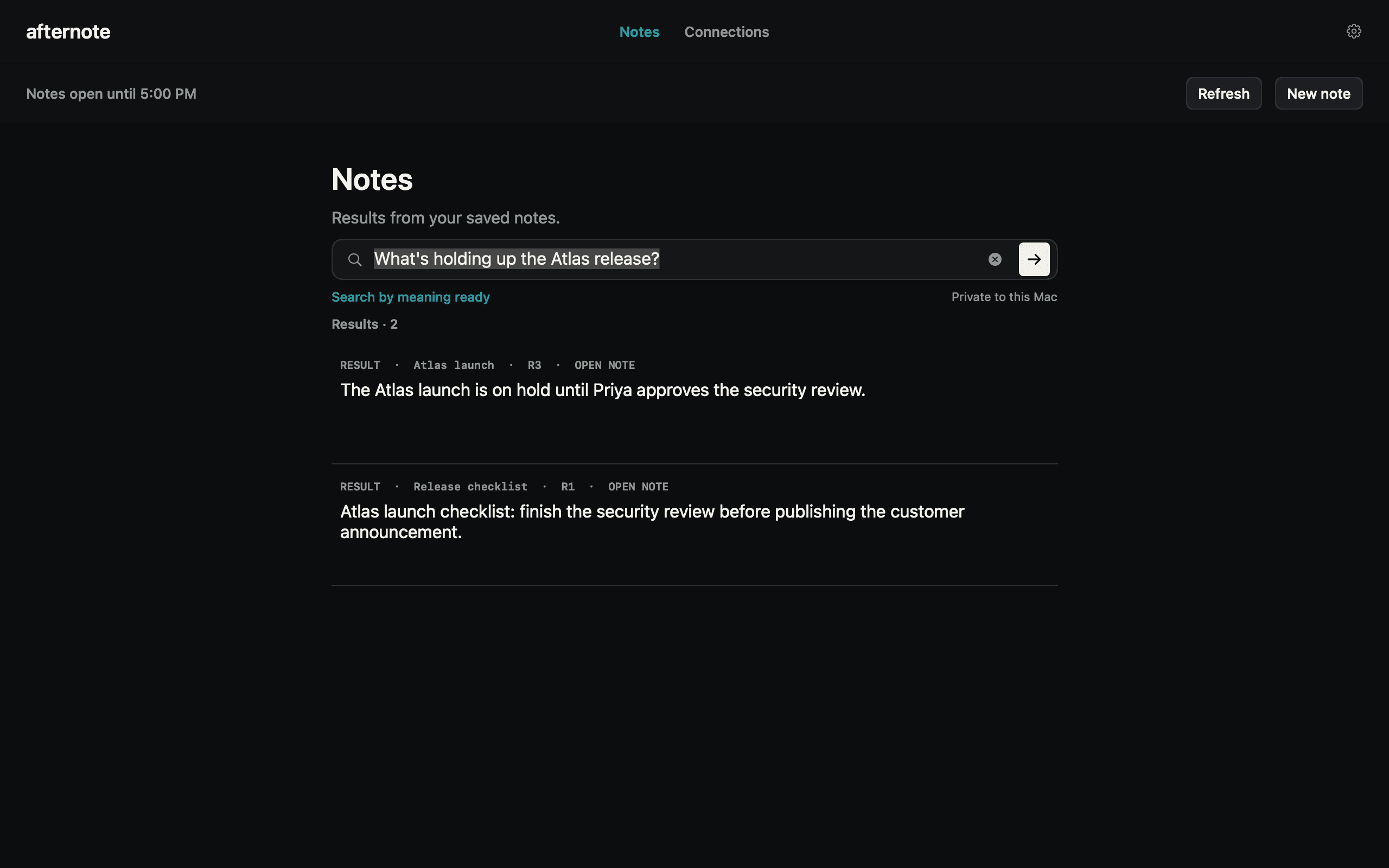
SAVED IN CLAUDE DESKTOPThe Atlas launch is on hold until Priya approves the security review.
ASKED LATER IN CODEXWhat’s holding up the Atlas release?
The saved note comes back with its source. You can also read, search, and edit notes in Afternote itself.
Why I built Afternote
I didn’t want AI to capture everything. I wanted it to remember what I chose.
I wanted to save something in one conversation and find it in the next, even if I had switched apps. I wanted to choose what was worth keeping and get back to it without remembering the exact words.
That meant giving those notes one home, with a native app I could open myself and connections to the tools I already use. Each tool needs approval, and I can inspect its activity or revoke access.
I built Afternote outside my day job. It is free and open source, with the encrypted vault and search running on my Mac.
Save it once. Find it in the next conversation or the next connected tool.
The loop
One note hub, wherever you work.
- 01
Save it deliberately.
Write in the native app, or tell Codex, Claude Code, or Claude Desktop to remember something. Afternote only saves what you explicitly choose.
- 02
Give it one durable home.
Every saved note enters the same encrypted local vault. Search by words, dates, or meaning. The local search models are included and ready to prepare your notes when you open the vault.
- 03
Recall it wherever you work next.
Search in Afternote, return in a new conversation, or ask from another connected tool. Results point back to the exact saved note so you can check the answer.
Security in this beta
Choose which tools can access your notes.
Approve each tool separately. See what it has done and revoke access from Afternote. Connections receive scoped permissions to save and recall notes; they never receive the vault’s encryption key.
Recalled text goes to the AI tool you ask and may reach its model provider. Read the security model and its limits.
- Storage
- Encrypted SQLCipher vault on this Mac
- Accounts
- No Afternote account required
- Connections
- Separately authorized and revocable
- Search
- Runs on this Mac with exact citations
- Telemetry
- No app usage telemetry collected
Questions
The honest version.
Can I download Afternote Local today?
Yes. Beta 5 is a free, signed and notarized download for Apple Silicon Macs running macOS 13.3 or newer. Open the DMG, drag Afternote into Applications, and open it from there. The search models are included; no account, build tools, or separate model download is needed. The GitHub release includes checksums and verification instructions.
What stays on my Mac?
The encrypted vault and search stay on your Mac. Search by meaning is enabled by default in Afternote and approved connected tools. Its models are included, and search runs locally. Recalled text is sent to the connected AI host and may be processed by its provider. Signed update checks use the network. Afternote Local does not upload your vault or collect app usage telemetry.
What can connect today?
Codex, Claude Code, and Claude Desktop support saving, recall, and exact-source retrieval. Use one host across separate conversations, or share saved notes across hosts. Each connection is separately authorized and revocable. Managed Claude organizations may restrict custom extensions. ChatGPT consumer apps, browser connectors, and Slack are not included.
What happened to the original Afternote web app?
It is still available for existing users, but I am not promoting new hosted sign-ups. Existing users can find the hosted sign-in and a direct help email in the footer if their notes are not where they expect.
Is Afternote Local open source?
Yes. The complete Local app is available on GitHub under Apache-2.0, with build instructions, tests, architecture documentation, and the security model. The original hosted product is a separate repository. You can download the Mac app without building it yourself.
See one saved note move across tools.
Independently maintained, best-effort beta. Beta notice and license · Local privacy.